EXERCISE 6.2
Triangles • 10 Questions
Question 1
Hint available
In Fig. 6.17, (i) and (ii), DE || BC. Find EC in (i) and AD in (ii). Fig. 6.17
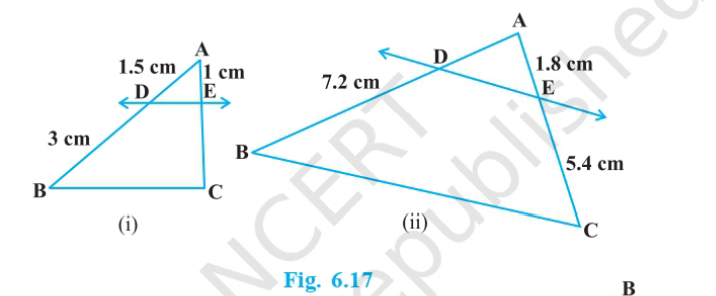
Key Idea
Use the Basic Proportionality Theorem (Thales theorem): If a line drawn through a triangle is parallel to one side, it divides the other two sides proportionally. Hence, for DE ∥ BC, \(\frac{AD}{AB}=\frac{AE}{AC}=\frac{DE}{BC}\).
Step-by-Step Solution
### (i) Find \(EC\)
1. Given: \(AB = 12\,\text{cm},\; AD = 4\,\text{cm},\; AC = 9\,\text{cm}\).
2. Since \(DE \parallel BC\), by the Basic Proportionality Theorem,
$$\frac{AD}{AB}=\frac{AE}{AC}.$$
3. Substitute the known values:
$$\frac{4}{12}=\frac{AE}{9}\;\Rightarrow\;AE = \frac{4}{12}\times 9 = 3\,\text{cm}.$$
4. On side \(AC\), \(AE + EC = AC\). Hence,
$$EC = AC - AE = 9 - 3 = 6\,\text{cm}.$$
5. Answer: \(EC = 6\,\text{cm}\).
### (ii) Find \(AD\)
1. Given: \(AB = 12\,\text{cm},\; AC = 9\,\text{cm},\; EC = 6\,\text{cm}\).
2. First find \(AE\):
$$AE = AC - EC = 9 - 6 = 3\,\text{cm}.$$
3. Again, using the Basic Proportionality Theorem,
$$\frac{AD}{AB}=\frac{AE}{AC}.$$
4. Substitute the known values:
$$\frac{AD}{12}=\frac{3}{9}\;\Rightarrow\;AD = \frac{3}{9}\times 12 = 4\,\text{cm}.$$
5. Answer: \(AD = 4\,\text{cm}\).
1. Given: \(AB = 12\,\text{cm},\; AD = 4\,\text{cm},\; AC = 9\,\text{cm}\).
2. Since \(DE \parallel BC\), by the Basic Proportionality Theorem,
$$\frac{AD}{AB}=\frac{AE}{AC}.$$
3. Substitute the known values:
$$\frac{4}{12}=\frac{AE}{9}\;\Rightarrow\;AE = \frac{4}{12}\times 9 = 3\,\text{cm}.$$
4. On side \(AC\), \(AE + EC = AC\). Hence,
$$EC = AC - AE = 9 - 3 = 6\,\text{cm}.$$
5. Answer: \(EC = 6\,\text{cm}\).
### (ii) Find \(AD\)
1. Given: \(AB = 12\,\text{cm},\; AC = 9\,\text{cm},\; EC = 6\,\text{cm}\).
2. First find \(AE\):
$$AE = AC - EC = 9 - 6 = 3\,\text{cm}.$$
3. Again, using the Basic Proportionality Theorem,
$$\frac{AD}{AB}=\frac{AE}{AC}.$$
4. Substitute the known values:
$$\frac{AD}{12}=\frac{3}{9}\;\Rightarrow\;AD = \frac{3}{9}\times 12 = 4\,\text{cm}.$$
5. Answer: \(AD = 4\,\text{cm}\).
Question 2
Hint available
E and F are points on the sides PQ and PR respectively of a PQR. For each of the following cases, state whether EF || QR : (i) PE = 3.9 cm, EQ = 3 cm, PF = 3.6 cm and FR = 2.4 cm (ii) PE = 4 cm, QE = 4.5 cm, PF = 8 cm and RF = 9 cm (iii) PQ = 1.28 cm, PR = 2.56 cm, PE = 0.18 cm and PF = 0.36 cm
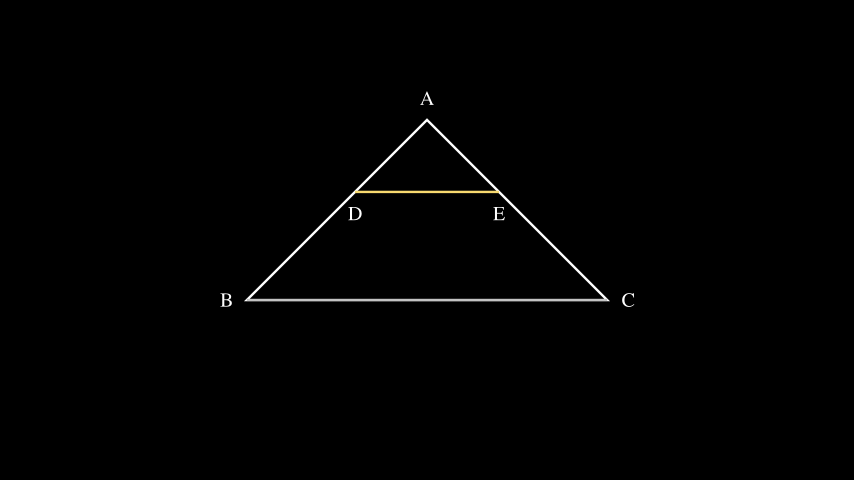
Key Idea
Use the Basic Proportionality Theorem (also called Thales’ theorem): In Δ PQR, a line joining points E on PQ and F on PR is parallel to QR iff it divides the two sides proportionally, i.e., \(\frac{PE}{EQ}=\frac{PF}{FR}\) or equivalently \(\frac{PE}{PQ}=\frac{PF}{PR}\).
Step-by-Step Solution
1. Recall the theorem – For Δ PQR, \(EF\parallel QR\) ⇔ \(\dfrac{PE}{EQ}=\dfrac{PF}{FR}\) (or \(\dfrac{PE}{PQ}=\dfrac{PF}{PR}\)).
2. Case (i)
- Compute \(\dfrac{PE}{EQ}=\dfrac{3.9}{3}=1.30\).
- Compute \(\dfrac{PF}{FR}=\dfrac{3.6}{2.4}=1.50\).
- Since \(1.30
eq 1.50\), the ratios are not equal.
- Conclusion: \(EF\) is not parallel to \(QR\).
3. Case (ii)
- Compute \(\dfrac{PE}{EQ}=\dfrac{4}{4.5}=\dfrac{8}{9}=0.888\ldots\).
- Compute \(\dfrac{PF}{FR}=\dfrac{8}{9}=0.888\ldots\).
- The two ratios are equal.
- Conclusion: \(EF\) is parallel to \(QR\).
4. Case (iii) – Here the whole side lengths are given, so use the alternative form of the theorem.
- \(\dfrac{PE}{PQ}=\dfrac{0.18}{1.28}=0.140625\).
- \(\dfrac{PF}{PR}=\dfrac{0.36}{2.56}=0.140625\).
- The ratios are equal.
- Conclusion: \(EF\) is parallel to \(QR\).
5. Summary of answers
- (i) No, \(EF\) is not parallel to \(QR\).
- (ii) Yes, \(EF\) is parallel to \(QR\).
- (iii) Yes, \(EF\) is parallel to \(QR\).
2. Case (i)
- Compute \(\dfrac{PE}{EQ}=\dfrac{3.9}{3}=1.30\).
- Compute \(\dfrac{PF}{FR}=\dfrac{3.6}{2.4}=1.50\).
- Since \(1.30
eq 1.50\), the ratios are not equal.
- Conclusion: \(EF\) is not parallel to \(QR\).
3. Case (ii)
- Compute \(\dfrac{PE}{EQ}=\dfrac{4}{4.5}=\dfrac{8}{9}=0.888\ldots\).
- Compute \(\dfrac{PF}{FR}=\dfrac{8}{9}=0.888\ldots\).
- The two ratios are equal.
- Conclusion: \(EF\) is parallel to \(QR\).
4. Case (iii) – Here the whole side lengths are given, so use the alternative form of the theorem.
- \(\dfrac{PE}{PQ}=\dfrac{0.18}{1.28}=0.140625\).
- \(\dfrac{PF}{PR}=\dfrac{0.36}{2.56}=0.140625\).
- The ratios are equal.
- Conclusion: \(EF\) is parallel to \(QR\).
5. Summary of answers
- (i) No, \(EF\) is not parallel to \(QR\).
- (ii) Yes, \(EF\) is parallel to \(QR\).
- (iii) Yes, \(EF\) is parallel to \(QR\).
Question 3
Hint available
In Fig. 6.18, if LM || CB and LN || CD, prove that AM AN AB AD
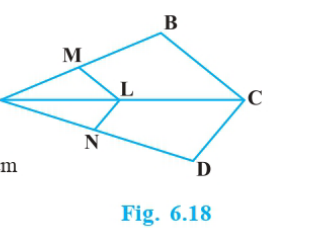
Key Idea
Use the parallelism to establish similarity of triangles $\triangle AML \sim \triangle ACB$ and $\triangle ANL \sim \triangle ADC$. From the similarity obtain the proportionality $\dfrac{AM}{AB}=\dfrac{AL}{AC}=\dfrac{AN}{AD}$, which leads to the required product relation.
Step-by-Step Solution
1. Identify similar triangles\
- Since $LM \parallel CB$, the angle $\angle AML$ equals $\angle ACB$ (alternate interior angles) and $\angle ALM$ equals $\angle ABC$. Hence \[ \triangle AML \sim \triangle ACB. \]
- Since $LN \parallel CD$, the angle $\angle ANL$ equals $\angle ADC$ and $\angle ALN$ equals $\angle ACD$. Hence \[ \triangle ANL \sim \triangle ADC. \]
2. Write the corresponding side ratios\
From $\triangle AML \sim \triangle ACB$ we have\
\[ \frac{AM}{AB}=\frac{AL}{AC}=\frac{ML}{CB}. \tag{1} \]
From $\triangle ANL \sim \triangle ADC$ we have\
\[ \frac{AN}{AD}=\frac{AL}{AC}=\frac{NL}{DC}. \tag{2} \]
3. Equate the common ratio\
Both (1) and (2) contain the ratio $\dfrac{AL}{AC}$. Therefore\
\[ \frac{AM}{AB}=\frac{AN}{AD}. \]
4. Cross‑multiply\
\[ AM \cdot AD = AN \cdot AB. \]
5. Conclusion\
Hence, $AM \cdot AN = AB \cdot AD$, which is what had to be proved.
- Since $LM \parallel CB$, the angle $\angle AML$ equals $\angle ACB$ (alternate interior angles) and $\angle ALM$ equals $\angle ABC$. Hence \[ \triangle AML \sim \triangle ACB. \]
- Since $LN \parallel CD$, the angle $\angle ANL$ equals $\angle ADC$ and $\angle ALN$ equals $\angle ACD$. Hence \[ \triangle ANL \sim \triangle ADC. \]
2. Write the corresponding side ratios\
From $\triangle AML \sim \triangle ACB$ we have\
\[ \frac{AM}{AB}=\frac{AL}{AC}=\frac{ML}{CB}. \tag{1} \]
From $\triangle ANL \sim \triangle ADC$ we have\
\[ \frac{AN}{AD}=\frac{AL}{AC}=\frac{NL}{DC}. \tag{2} \]
3. Equate the common ratio\
Both (1) and (2) contain the ratio $\dfrac{AL}{AC}$. Therefore\
\[ \frac{AM}{AB}=\frac{AN}{AD}. \]
4. Cross‑multiply\
\[ AM \cdot AD = AN \cdot AB. \]
5. Conclusion\
Hence, $AM \cdot AN = AB \cdot AD$, which is what had to be proved.
Question 4
Hint available
In Fig. 6.19, DE || AC and DF || AE. Prove that BF BE FE EC Fig. 6.18 Fig. 6.19 85
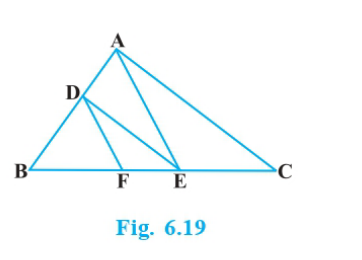
Key Idea
Use the parallel lines to obtain similar triangles. From DE ∥ AC we get \(\triangle DFE \sim \triangle AEC\). From DF ∥ AE we get \(\triangle BDF \sim \triangle BAE\). The two similarity relations give the proportion \(\frac{BF}{BE}=\frac{DF}{AE}=\frac{FE}{EC}\), which after cross‑multiplication yields the required product relation.
Step-by-Step Solution
1. Identify the similar triangles\
- Since \(DE \parallel AC\), the angles \(\angle DFE\) and \(\angle AEC\) are equal and \(\angle D EF\) and \(\angle A C E\) are equal. Hence\
$$\triangle DFE \sim \triangle AEC.$$\
- Since \(DF \parallel AE\), the angles \(\angle BDF\) and \(\angle BAE\) are equal and \(\angle BFD\) and \(\angle BEA\) are equal. Hence\
$$\triangle BDF \sim \triangle BAE.$$\
2. Write the proportionalities from the similar triangles\
- From \(\triangle DFE \sim \triangle AEC\):\
$$\frac{DF}{AE}=\frac{DE}{AC}=\frac{FE}{EC}\quad\Rightarrow\quad\frac{DF}{AE}=\frac{FE}{EC}. \tag{1}$$\
- From \(\triangle BDF \sim \triangle BAE\):\
$$\frac{BD}{BA}=\frac{BF}{BE}=\frac{DF}{AE}\quad\Rightarrow\quad\frac{BF}{BE}=\frac{DF}{AE}. \tag{2}$$\
3. Combine (1) and (2)\
From (2) we have \(\frac{BF}{BE}=\frac{DF}{AE}\). Using (1) to replace \(\frac{DF}{AE}\) we obtain\
$$\frac{BF}{BE}=\frac{FE}{EC}.$$\
4. Cross‑multiply\
$$BF\cdot EC = BE\cdot FE.$$\
Hence the required relation \(BF\,BE = FE\,EC\) is proved.
Conclusion: By establishing two pairs of similar triangles using the given parallel lines, we derived the proportion \(\frac{BF}{BE}=\frac{FE}{EC}\) which directly leads to the product equality \(BF\cdot BE = FE\cdot EC\).
- Since \(DE \parallel AC\), the angles \(\angle DFE\) and \(\angle AEC\) are equal and \(\angle D EF\) and \(\angle A C E\) are equal. Hence\
$$\triangle DFE \sim \triangle AEC.$$\
- Since \(DF \parallel AE\), the angles \(\angle BDF\) and \(\angle BAE\) are equal and \(\angle BFD\) and \(\angle BEA\) are equal. Hence\
$$\triangle BDF \sim \triangle BAE.$$\
2. Write the proportionalities from the similar triangles\
- From \(\triangle DFE \sim \triangle AEC\):\
$$\frac{DF}{AE}=\frac{DE}{AC}=\frac{FE}{EC}\quad\Rightarrow\quad\frac{DF}{AE}=\frac{FE}{EC}. \tag{1}$$\
- From \(\triangle BDF \sim \triangle BAE\):\
$$\frac{BD}{BA}=\frac{BF}{BE}=\frac{DF}{AE}\quad\Rightarrow\quad\frac{BF}{BE}=\frac{DF}{AE}. \tag{2}$$\
3. Combine (1) and (2)\
From (2) we have \(\frac{BF}{BE}=\frac{DF}{AE}\). Using (1) to replace \(\frac{DF}{AE}\) we obtain\
$$\frac{BF}{BE}=\frac{FE}{EC}.$$\
4. Cross‑multiply\
$$BF\cdot EC = BE\cdot FE.$$\
Hence the required relation \(BF\,BE = FE\,EC\) is proved.
Conclusion: By establishing two pairs of similar triangles using the given parallel lines, we derived the proportion \(\frac{BF}{BE}=\frac{FE}{EC}\) which directly leads to the product equality \(BF\cdot BE = FE\cdot EC\).
Question 5
Hint available
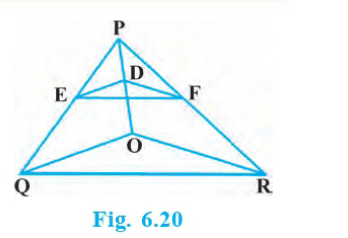
In Fig. 6.20, DE || OQ and DF || OR. Show that EF || QR.
Key Idea
Use the concept of similarity of triangles formed by parallel lines. Since DE is parallel to OQ and DF is parallel to OR, the angles of triangle DEF are equal to the corresponding angles of triangle OQR (AA similarity). Hence triangle DEF ∼ triangle OQR, which implies the third pair of corresponding sides are parallel, i.e., EF ∥ QR.
Step-by-Step Solution
1. Identify the given parallels:\
- DE ∥ OQ \
- DF ∥ OR
2. Compare the angles:\
- Because DE ∥ OQ, the angle formed by DE with DF equals the angle formed by OQ with OR. Hence \[ \angle EDF = \angle QOR \] (corresponding angles).\
- Because DF ∥ OR, the angle formed by DF with DE equals the angle formed by OR with OQ. Hence \[ \angle E D F = \angle R O Q \] (again, corresponding angles).
3. Establish similarity:\
- In triangle OQR, the two angles \(\angle QOR\) and \(\angle ROQ\) are known.\
- In triangle DEF, we have shown that \(\angle EDF = \angle QOR\) and \(\angle E D F = \angle R O Q\).\
- Therefore, by the AA (Angle‑Angle) criterion, \[ \triangle DEF \sim \triangle OQR \].
4. Correspondence of sides:\
- From the similarity, the side opposite \(\angle QOR\) in \(\triangle OQR\) is \(QR\).\
- The side opposite \(\angle EDF\) in \(\triangle DEF\) is \(EF\).\
- Hence the pair of corresponding sides are \(EF\) and \(QR\).
5. Conclude parallelism:\
- Corresponding sides of similar triangles are parallel. Therefore, \[ EF \parallel QR. \]
Thus, the required result is proved.
- DE ∥ OQ \
- DF ∥ OR
2. Compare the angles:\
- Because DE ∥ OQ, the angle formed by DE with DF equals the angle formed by OQ with OR. Hence \[ \angle EDF = \angle QOR \] (corresponding angles).\
- Because DF ∥ OR, the angle formed by DF with DE equals the angle formed by OR with OQ. Hence \[ \angle E D F = \angle R O Q \] (again, corresponding angles).
3. Establish similarity:\
- In triangle OQR, the two angles \(\angle QOR\) and \(\angle ROQ\) are known.\
- In triangle DEF, we have shown that \(\angle EDF = \angle QOR\) and \(\angle E D F = \angle R O Q\).\
- Therefore, by the AA (Angle‑Angle) criterion, \[ \triangle DEF \sim \triangle OQR \].
4. Correspondence of sides:\
- From the similarity, the side opposite \(\angle QOR\) in \(\triangle OQR\) is \(QR\).\
- The side opposite \(\angle EDF\) in \(\triangle DEF\) is \(EF\).\
- Hence the pair of corresponding sides are \(EF\) and \(QR\).
5. Conclude parallelism:\
- Corresponding sides of similar triangles are parallel. Therefore, \[ EF \parallel QR. \]
Thus, the required result is proved.
Question 6
Hint available
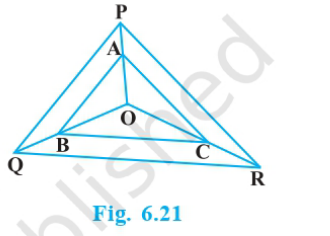
In Fig. 6.21, A, B and C are points on OP, OQ and OR respectively such that AB || PQ and AC || PR. Show that BC || QR.
Key Idea
Use the similarity of triangles created by the given parallel lines (Basic Proportionality Theorem). From AB ∥ PQ we get similarity of ΔOAB and ΔOPQ; from AC ∥ PR we get similarity of ΔOAC and ΔOPR. Equating the corresponding ratios gives OB/OQ = OC/OR, which implies similarity of ΔOBC and ΔOQR, leading to BC ∥ QR.
Step-by-Step Solution
1. Use the given parallelism AB ∥ PQ
- Since AB is parallel to PQ, the corresponding angles are equal:
$$\angle OAB = \angle OPQ \quad \text{and} \quad \angle OBA = \angle OQP.$$
- Hence, ΔOAB ∼ ΔOPQ (AA similarity).
- Therefore,
$$\frac{OA}{OP}=\frac{OB}{OQ}=\frac{AB}{PQ}\tag{1}$$
2. Use the given parallelism AC ∥ PR
- Similarly, because AC is parallel to PR,
$$\angle OAC = \angle OPR \quad \text{and} \quad \angle OCA = \angle ORP.$$
- Hence, ΔOAC ∼ ΔOPR (AA similarity).
- Consequently,
$$\frac{OA}{OP}=\frac{OC}{OR}=\frac{AC}{PR}\tag{2}$$
3. Equate the common ratio
- From (1) and (2) the first ratios are equal, so
$$\frac{OB}{OQ}=\frac{OC}{OR}\tag{3}$$
4. Show similarity of ΔOBC and ΔOQR
- In ΔOBC and ΔOQR we have:
- \(\angle BOC\) is common.
- From (3) the sides about this angle are in proportion:
$$\frac{OB}{OQ}=\frac{OC}{OR}.$$
- Hence, by SAS similarity, ΔOBC ∼ ΔOQR.
5. Conclude the required parallelism
- Corresponding angles of similar triangles are equal, therefore
$$\angle OBC = \angle OQR \quad \text{and} \quad \angle OCB = \angle ORQ.$$
- Equal corresponding angles imply that the sides opposite them are parallel, i.e.
$$BC \parallel QR.$$
Thus, BC is parallel to QR, as required.
- Since AB is parallel to PQ, the corresponding angles are equal:
$$\angle OAB = \angle OPQ \quad \text{and} \quad \angle OBA = \angle OQP.$$
- Hence, ΔOAB ∼ ΔOPQ (AA similarity).
- Therefore,
$$\frac{OA}{OP}=\frac{OB}{OQ}=\frac{AB}{PQ}\tag{1}$$
2. Use the given parallelism AC ∥ PR
- Similarly, because AC is parallel to PR,
$$\angle OAC = \angle OPR \quad \text{and} \quad \angle OCA = \angle ORP.$$
- Hence, ΔOAC ∼ ΔOPR (AA similarity).
- Consequently,
$$\frac{OA}{OP}=\frac{OC}{OR}=\frac{AC}{PR}\tag{2}$$
3. Equate the common ratio
- From (1) and (2) the first ratios are equal, so
$$\frac{OB}{OQ}=\frac{OC}{OR}\tag{3}$$
4. Show similarity of ΔOBC and ΔOQR
- In ΔOBC and ΔOQR we have:
- \(\angle BOC\) is common.
- From (3) the sides about this angle are in proportion:
$$\frac{OB}{OQ}=\frac{OC}{OR}.$$
- Hence, by SAS similarity, ΔOBC ∼ ΔOQR.
5. Conclude the required parallelism
- Corresponding angles of similar triangles are equal, therefore
$$\angle OBC = \angle OQR \quad \text{and} \quad \angle OCB = \angle ORQ.$$
- Equal corresponding angles imply that the sides opposite them are parallel, i.e.
$$BC \parallel QR.$$
Thus, BC is parallel to QR, as required.
Question 7
Hint available
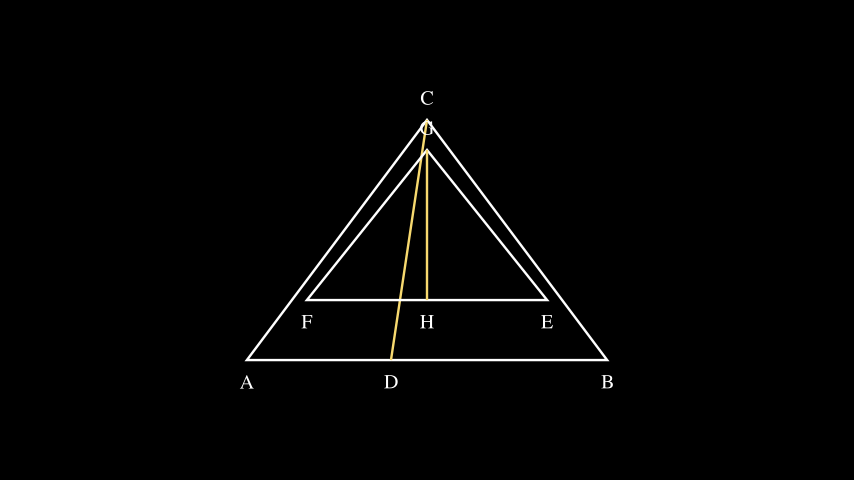
Using Theorem 6.1, prove that a line drawn through the mid-point of one side of a triangle parallel to another side bisects the third side. (Recall that you have proved it in Class IX).
Key Idea
Apply the Mid‑point Theorem (Theorem 6.1) to the triangle formed by the given side and the side parallel to it. By constructing similar triangles, the intercepted segment on the third side is shown to be equal to the other intercepted segment, proving it is a midpoint.
Step-by-Step Solution
1. Given: Triangle \(\triangle ABC\). Let \(M\) be the mid‑point of side \(AB\). Through \(M\) draw a line \(l\) parallel to side \(AC\) meeting \(BC\) at \(D\).
2. Apply Theorem 6.1 (Mid‑point Theorem) to \(\triangle ABC\):
- Since \(M\) is the midpoint of \(AB\) and \(l\parallel AC\), the segment \(MD\) is the line joining the mid‑point of one side to a point on the third side.
- By Theorem 6.1, the line joining the mid‑point of a side to a point on the third side that is parallel to the second side will intersect the third side at its midpoint.
3. Construct similar triangles:
- Because \(MD \parallel AC\), \(\angle MDB = \angle ACB\) (alternate interior angles).
- Also, \(\angle MDB = \angle ACB\) and \(\angle MBD = \angle ABC\) (common angle at \(B\)).
- Hence \(\triangle MBD \sim \triangle ACB\) (AA similarity).
4. Correspondence of sides:
- From similarity, \(\frac{MB}{AB} = \frac{BD}{CB}\).
- But \(MB = \frac{AB}{2}\) because \(M\) is the midpoint of \(AB\).
- Substituting, \(\frac{\frac{AB}{2}}{AB} = \frac{BD}{CB}\) \(\Rightarrow \frac{1}{2} = \frac{BD}{CB}\).
- Therefore \(BD = \frac{CB}{2}\).
5. Conclusion:
- Since \(BD = \frac{CB}{2}\), point \(D\) divides \(BC\) into two equal parts; i.e., \(D\) is the midpoint of \(BC\).
- Hence the line drawn through the mid‑point of one side of a triangle parallel to another side bisects the third side.
6. Remark: This is exactly the converse of the Mid‑point Theorem proved in Class IX, confirming the result.
2. Apply Theorem 6.1 (Mid‑point Theorem) to \(\triangle ABC\):
- Since \(M\) is the midpoint of \(AB\) and \(l\parallel AC\), the segment \(MD\) is the line joining the mid‑point of one side to a point on the third side.
- By Theorem 6.1, the line joining the mid‑point of a side to a point on the third side that is parallel to the second side will intersect the third side at its midpoint.
3. Construct similar triangles:
- Because \(MD \parallel AC\), \(\angle MDB = \angle ACB\) (alternate interior angles).
- Also, \(\angle MDB = \angle ACB\) and \(\angle MBD = \angle ABC\) (common angle at \(B\)).
- Hence \(\triangle MBD \sim \triangle ACB\) (AA similarity).
4. Correspondence of sides:
- From similarity, \(\frac{MB}{AB} = \frac{BD}{CB}\).
- But \(MB = \frac{AB}{2}\) because \(M\) is the midpoint of \(AB\).
- Substituting, \(\frac{\frac{AB}{2}}{AB} = \frac{BD}{CB}\) \(\Rightarrow \frac{1}{2} = \frac{BD}{CB}\).
- Therefore \(BD = \frac{CB}{2}\).
5. Conclusion:
- Since \(BD = \frac{CB}{2}\), point \(D\) divides \(BC\) into two equal parts; i.e., \(D\) is the midpoint of \(BC\).
- Hence the line drawn through the mid‑point of one side of a triangle parallel to another side bisects the third side.
6. Remark: This is exactly the converse of the Mid‑point Theorem proved in Class IX, confirming the result.
Question 8
Hint available
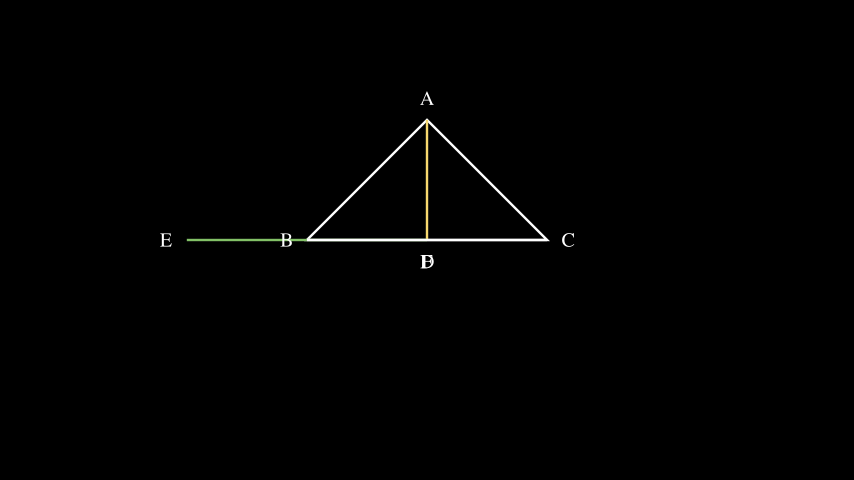
Using Theorem 6.2, prove that the line joining the mid-points of any two sides of a triangle is parallel to the third side. (Recall that you have done it in Class IX).
Key Idea
Apply the converse of the Mid‑point theorem (Theorem 6.2). If a line through the midpoint of one side of a triangle is parallel to a second side, then it bisects the third side. By constructing such a line and using the uniqueness of the midpoint, we obtain the required parallelism.
Step-by-Step Solution
1. Consider triangle \(\triangle ABC\).
Let \(D\) be the midpoint of side \(AB\) and \(E\) be the midpoint of side \(AC\).
2. Draw a line through \(D\) parallel to \(BC\).
Let this line intersect side \(AC\) at a point \(F\). Thus, \(DF \parallel BC\).
3. Apply Theorem 6.2 (converse of the Mid‑point theorem).
Since \(D\) is the midpoint of \(AB\) and \(DF\) is drawn through \(D\) parallel to \(BC\), Theorem 6.2 tells us that \(DF\) bisects the third side \(AC\). Hence, \(F\) is the midpoint of \(AC\).
4. Identify the midpoint on \(AC\).
By definition, the midpoint of \(AC\) is the point \(E\). Because a side has only one midpoint, we must have \(F \equiv E\).
5. Conclude the required parallelism.
The line joining the midpoints \(D\) and \(E\) is exactly the line \(DF\) constructed in step 2. Therefore, \(DE \parallel BC\).
6. Result.
Hence, the line joining the mid‑points of any two sides of a triangle is parallel to the third side.
Thus, \(DE \parallel BC\).
Let \(D\) be the midpoint of side \(AB\) and \(E\) be the midpoint of side \(AC\).
2. Draw a line through \(D\) parallel to \(BC\).
Let this line intersect side \(AC\) at a point \(F\). Thus, \(DF \parallel BC\).
3. Apply Theorem 6.2 (converse of the Mid‑point theorem).
Since \(D\) is the midpoint of \(AB\) and \(DF\) is drawn through \(D\) parallel to \(BC\), Theorem 6.2 tells us that \(DF\) bisects the third side \(AC\). Hence, \(F\) is the midpoint of \(AC\).
4. Identify the midpoint on \(AC\).
By definition, the midpoint of \(AC\) is the point \(E\). Because a side has only one midpoint, we must have \(F \equiv E\).
5. Conclude the required parallelism.
The line joining the midpoints \(D\) and \(E\) is exactly the line \(DF\) constructed in step 2. Therefore, \(DE \parallel BC\).
6. Result.
Hence, the line joining the mid‑points of any two sides of a triangle is parallel to the third side.
Thus, \(DE \parallel BC\).
Question 9
Hint available
ABCD is a trapezium in which AB || DC and its diagonals intersect each other at the point O. Show that AO CO BO DO
Key Idea
In a trapezium with one pair of opposite sides parallel, the intersecting diagonals form two pairs of similar triangles. Using the similarity of \(\triangle AOB \sim \triangle COD\) (or \(\triangle AOD \sim \triangle CBO\)) we obtain the proportionality \(\dfrac{AO}{CO}=\dfrac{BO}{DO}\). Cross‑multiplying gives the required relation \(AO\cdot DO = BO\cdot CO\), which, by the commutative property of multiplication, is equivalent to \(AO\cdot CO = BO\cdot DO\).
Step-by-Step Solution
1. Identify the similar triangles\
Since \(AB \parallel DC\), the alternate interior angles give\
\[\angle ABO = \angle CDO \quad\text{and}\quad \angle BAO = \angle DCO.\]
Also, the vertical angles at the intersection point \(O\) give\
\[\angle AOB = \angle COD.\]
Hence \(\triangle AOB \sim \triangle COD\) (AA similarity).
2. Write the proportion from similarity\
From the correspondence \(A \leftrightarrow C,\; B \leftrightarrow D,\; O \leftrightarrow O\), we have\
\[\frac{AO}{CO}=\frac{AB}{CD}=\frac{BO}{DO}.\]
In particular,\
\[\frac{AO}{CO}=\frac{BO}{DO}.\]
3. Cross‑multiply\
\[AO\cdot DO = BO\cdot CO.\]
Since multiplication of real numbers is commutative, the equality can be written as\
\[AO\cdot CO = BO\cdot DO.\]
This is the required result.
4. Conclusion\
Thus, in a trapezium where the pair of opposite sides are parallel, the product of the segments of one diagonal equals the product of the segments of the other diagonal.
Remark: The same result can also be obtained by using the other pair of similar triangles \(\triangle AOD \sim \triangle CBO\). Both approaches lead to the same proportionality and hence the same product relation.
Since \(AB \parallel DC\), the alternate interior angles give\
\[\angle ABO = \angle CDO \quad\text{and}\quad \angle BAO = \angle DCO.\]
Also, the vertical angles at the intersection point \(O\) give\
\[\angle AOB = \angle COD.\]
Hence \(\triangle AOB \sim \triangle COD\) (AA similarity).
2. Write the proportion from similarity\
From the correspondence \(A \leftrightarrow C,\; B \leftrightarrow D,\; O \leftrightarrow O\), we have\
\[\frac{AO}{CO}=\frac{AB}{CD}=\frac{BO}{DO}.\]
In particular,\
\[\frac{AO}{CO}=\frac{BO}{DO}.\]
3. Cross‑multiply\
\[AO\cdot DO = BO\cdot CO.\]
Since multiplication of real numbers is commutative, the equality can be written as\
\[AO\cdot CO = BO\cdot DO.\]
This is the required result.
4. Conclusion\
Thus, in a trapezium where the pair of opposite sides are parallel, the product of the segments of one diagonal equals the product of the segments of the other diagonal.
Remark: The same result can also be obtained by using the other pair of similar triangles \(\triangle AOD \sim \triangle CBO\). Both approaches lead to the same proportionality and hence the same product relation.
Question 10
Hint available
The diagonals of a quadrilateral ABCD intersect each other at the point O such that AO CO BO DO Show that ABCD is a trapezium. 6.4 Criteria for Similarity of In the previous section, we stated that two are similar, if (i) their corresponding angles are equal and (ii) their corresponding sides are in the same ratio (or proportion). That is, in ABC and DEF, if (i) A = D, B = E, C = F and (ii) AB BC CA , DE EF FD then the two are similar (see Fig. 6.22). Fig. 6.22 Fig. 6.20 Fig. 6.21 86 Here, you can see that A corresponds to D, B corresponds to E and C corresponds to F. Symbolically, we write the similarity of these two as ‘ ABC ~ DEF’ and read it as ‘triangle ABC is similar to triangle DEF’. The symbol ‘~’ stands for ‘is similar to’. Recall that you have used the symbol ‘’ for ‘is congruent to’ in Class IX. It must be noted that as done in the case of congruency of two , the similarity of two should also be expressed symbolically, using correct correspondence of their vertices. For example, for the ABC and DEF of Fig. 6.22, we cannot write ABC ~ EDF or ABC ~ FED. However, we can write BAC ~ EDF. Now a natural question arises : For checking the similarity of two , say ABC and DEF, should we always look for all the equality relations of their corresponding angles ( A = D, B = E, C = F) and all the equality relations of the ratios of their corresponding sides AB BC CA DE EF FD ? Let us examine. You may recall that in Class IX, you have obtained some criteria for congruency of two involving only three pairs of corresponding parts (or elements) of the two . Here also, let us make an attempt to arrive at certain criteria for similarity of two involving relationship between less number of pairs of corresponding parts of the two , instead of all the six pairs of corresponding parts. For this, let us perform the following activity: Activity 4 : Draw two line segments BC and EF of two different lengths, say 3 cm and 5 cm respectively. Then, at the points B and C respectively, construct angles PBC and QCB of some measures, say, 60° and 40°. Also, at the points E and F, construct angles REF and SFE of 60° and 40° respectively (see Fig. 6.23). Fig. 6.23 87 Let rays BP and CQ intersect each other at A and rays ER and FS intersect each other at D. In the two ABC and DEF, you can see that B = E, C = F and A = D. That is, corresponding angles of these two are equal. What can you say about their corresponding sides ? Note that BC 3 0.6. EF 5 What about AB DE and CA FD ? On measuring AB, DE, CA and FD, you will find that AB DE and CA FD are also equal to 0.6 (or nearly equal to 0.6, if there is some error in the measurement). Thus, AB BC CA DE EF FD You can repeat this activity by constructing several pairs of having their corresponding angles equal. Every time, you will find that their corresponding sides are in the same ratio (or proportion). This activity leads us to the following criterion for similarity of two .
Key Idea
Use the given relation to obtain a proportion between the sides of the two triangles formed by the intersecting diagonals. Together with the vertical angle at O, apply the SAS similarity criterion to triangles AOB and COD (or AOD and BOC). From the similarity deduce that a pair of opposite sides are parallel, which proves that the quadrilateral is a trapezium.
Step-by-Step Solution
1. Given condition
$$AO\cdot CO = BO\cdot DO$$
Since none of the segments are zero, we can rewrite it as a proportion:
$$\frac{AO}{BO}=\frac{DO}{CO}\tag{1}$$
2. Identify two triangles
Consider triangles \(\triangle AOB\) and \(\triangle COD\). They share the vertical angle at O:
$$\angle AOB = \angle COD\tag{2}$$
3. Apply SAS similarity
From (1) we have the ratio of the two sides surrounding the angle O in the two triangles, and from (2) the included angles are equal. Hence, by the SAS (Side‑Angle‑Side) similarity criterion,
$$\triangle AOB \sim \triangle COD\tag{3}$$
4. Corresponding angles are equal
From (3) we obtain
$$\angle ABO = \angle CDO\tag{4}$$
(Angle \(ABO\) is formed by \(AB\) and \(BO\); angle \(CDO\) is formed by \(CD\) and \(DO\)).
5. Conclude parallelism
Since \(BO\) and \(DO\) are the same straight line (they intersect at O), equality of the angles in (4) implies that the other sides are parallel:
$$AB \parallel CD\tag{5}$$
6. Definition of a trapezium
A trapezium (trapezoid) is a quadrilateral having at least one pair of opposite sides parallel. From (5) we have shown that \(AB\) and \(CD\) are parallel, therefore \(ABCD\) is a trapezium.
Hence, the quadrilateral ABCD is a trapezium.
$$AO\cdot CO = BO\cdot DO$$
Since none of the segments are zero, we can rewrite it as a proportion:
$$\frac{AO}{BO}=\frac{DO}{CO}\tag{1}$$
2. Identify two triangles
Consider triangles \(\triangle AOB\) and \(\triangle COD\). They share the vertical angle at O:
$$\angle AOB = \angle COD\tag{2}$$
3. Apply SAS similarity
From (1) we have the ratio of the two sides surrounding the angle O in the two triangles, and from (2) the included angles are equal. Hence, by the SAS (Side‑Angle‑Side) similarity criterion,
$$\triangle AOB \sim \triangle COD\tag{3}$$
4. Corresponding angles are equal
From (3) we obtain
$$\angle ABO = \angle CDO\tag{4}$$
(Angle \(ABO\) is formed by \(AB\) and \(BO\); angle \(CDO\) is formed by \(CD\) and \(DO\)).
5. Conclude parallelism
Since \(BO\) and \(DO\) are the same straight line (they intersect at O), equality of the angles in (4) implies that the other sides are parallel:
$$AB \parallel CD\tag{5}$$
6. Definition of a trapezium
A trapezium (trapezoid) is a quadrilateral having at least one pair of opposite sides parallel. From (5) we have shown that \(AB\) and \(CD\) are parallel, therefore \(ABCD\) is a trapezium.
Hence, the quadrilateral ABCD is a trapezium.